Add illumination to a cell plot
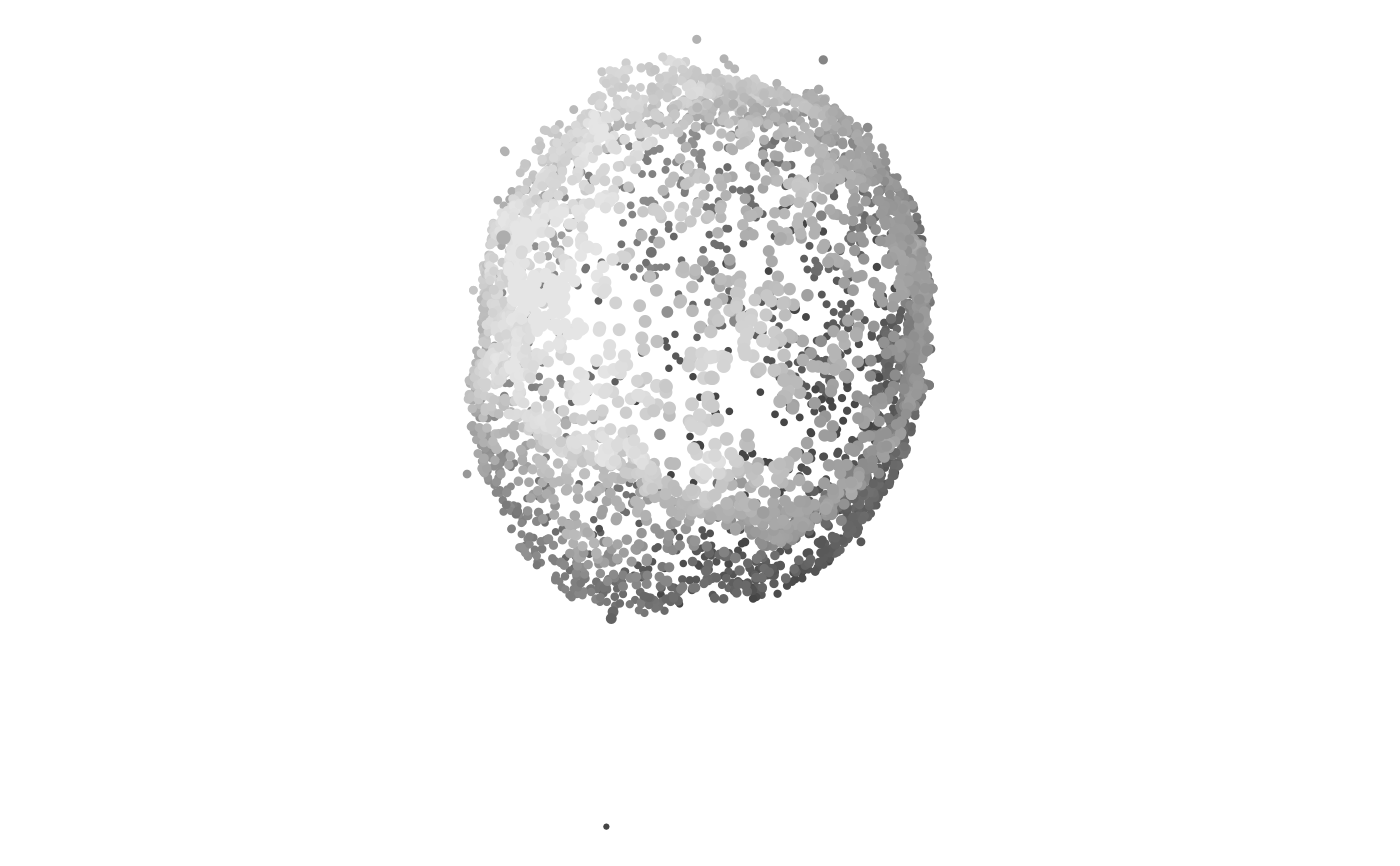
cell_illuminate.RdRecords geometry-based illumination parameters. During build_cell_plot(),
directional light, radial volume shading, and ambient occlusion are
calculated independently within each non-empty panel after color-scale
training. The resulting mask changes rendered point colors, while the
unilluminated scale remains the source for the legend.
Arguments
- object
A
cell_plotrecipe.- clamp_quantiles
Two ordered quantiles between zero and one used to clamp illumination.
- directional_light_weight, volume_shading_weight, ambient_occlusion_weight
Non-negative weights for light from
light_direction, radial shading from the origin, and local neighbor density, respectively. At least one weight must be positive.- ambient_occlusion_k
Positive integer number of nearest neighbors used for ambient occlusion.
- ambient_intensity
Minimum brightness in fully shadowed regions, between zero and one.
- saturation_boost
Non-negative saturation increase in shadowed regions. Ignored when
shadow_colorsis supplied.- shadow_colors
Optional vector of fully opaque colors used to tint shadows. When
NULL, illumination is applied in HSV color space.- light_direction
Three finite numeric values giving the x, y, and z direction of the light. The vector is normalized before it is stored. The default is a late afternoon sun, 45 degrees to the left of the camera and 25 degrees above the horizon. A light pointing straight at the camera, as in
light_direction = c(0, 0, 1), instead shades nodes by their depth.- lock_light
Whether an animation keeps
light_directionfixed while rotating the cell and recomputes illumination for every frame. This setting is only consumed by animation rendering; static and interactive plots use illumination calculated from the unrotated coordinates.
Details
Illumination masks are normalized within each panel. The requested number of ambient-occlusion neighbors is capped to the available points. Singleton panels and panels with a constant mask retain their original colors. Colors assigned to missing mapped values are not illuminated. Locked-light animations reuse rotation-invariant ambient occlusion and, when rotating around the coordinate origin, radial volume shading.
See also
cell_plot_animate(), cell_coord_rotate()
Other cell-plot-modifiers:
cell_annotation(),
cell_grid(),
cell_node_depth(),
cell_node_scale_alpha(),
cell_node_scale_color(),
cell_node_scale_size(),
cell_theme()
Examples
se <- ReadPNA_Seurat(minimal_pna_pxl_file())
#> duckdb keeps downloaded extensions and secrets in a temporary directory:
#> ℹ /tmp/Rtmp3BjCtL/duckdb
#> This is removed when the R session ends.
#> • Extensions are re-downloaded each session.
#> • Secrets are lost.
#> ℹ Run duckdb(shared_home = TRUE) (or create ~/.duckdb) to keep them (suitable for most users).
#> ℹ Run duckdb(shared_home = FALSE) to accept the temporary directory (and silence this message).
#> ℹ See ?duckdb_storage for details and alternatives.
#> ✔ Created a <Seurat> object with 5 cells and 158 targeted surface proteins
se <- LoadCellGraphs(se, cells = colnames(se)[4], verbose = FALSE) |>
  ComputeLayout(layout_method = "spectral")
#> duckdb keeps downloaded extensions and secrets in a temporary directory:
#> ℹ /tmp/Rtmp3BjCtL/duckdb
#> This is removed when the R session ends.
#> • Extensions are re-downloaded each session.
#> • Secrets are lost.
#> ℹ Run duckdb(shared_home = TRUE) (or create ~/.duckdb) to keep them (suitable for most users).
#> ℹ Run duckdb(shared_home = FALSE) to accept the temporary directory (and silence this message).
#> ℹ See ?duckdb_storage for details and alternatives.
#> ℹ Computing layouts for 1 graphs

cell_graph <- CellGraphs(se)[[4]]

layout_data <- FetchLayoutData(cell_graph, vars = "CD82", layout_method = "spectral_3d") |>
  # Downsample to speed up tests
  dplyr::slice_sample(n = 5000)

cell_plot(layout_data) |>
  cell_illuminate()